
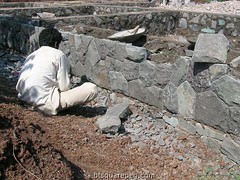
Stonework for Plinth at Pune

I’ve always advocated that small structures should be built using load- bearing walls because, to my mind, reinforced concrete cement (RCC) is not merely a waste of high-energy material but is, most of the time, very badly cast as well.

For the plinth, I usually specify random rubble – it is cheap, stable and highly effective as a detterent to dampness. In the Pune project, I decided to semi-dress the stone. Although it costs a bit more, it does look so much better. The guys who specialise in this work are plentiful in Pune and much better at what they do than the ones I’ve come across elsewhere.

They were a bit surprised, though, that I wanted it random and not shaped into rectangular blocks. It seems there are only two varieties of people these days – those who use the stone undressed and those who want ashlar. The path I chose is, apparently, the one least trod.

Smart Glass

We all know about Polaroid glass – it’s been around for ages. But this is a new one for me at least and has greater potential because the level of transparency/opacity is controlled by the user and not by ambient light.

SPD smart window is constructed by using two panes of glass separated by a conductive film with suspended, light absorbing, microscopic particles. Microscopic light-absorbing particles are dispersed within a thin film. When no electrical voltage is applied to the film, these particles absorb light, making the glass dark. When voltage is applied, the particles align and allow light to pass through. By simply adjusting the electrical voltage manually or automatically, the amount of light passing through the SPD-glass product can be controlled quickly and precisely.

A competing technology with SPD smart windows is the electrochromic smart window. Electrochromic windows consist of two glass panes with several layers sandwiched in between. It works by passing low-voltage electrical charges across a microscopically-thin coating on the glass surface, activating an electrochromic layer which changes color from clear to dark. The electric current can be activated manually or by sensors which react to light intensity. One advantage of the electrochromic smart window is that it only requires electricity to change its opacity, but not to maintain a particular shade.

Link: Smart Glass

Flexible Solar Panels

For architects, this, in whatever form it finally takes, is going to be an absolute boon.

Imagine being able to paint a renewable energy source on the walls of your house, without having to shell out most of your life’s earnings.

Well, this may no longer be in the realm of fantasy, with researchers from New Mexico State University and Wake Forest University working on an organic solar panel that is not only flexible, but can also be wrapped around structures, and comes much cheaper than the conventional ones.

Unlike traditional solar panels, which are made of silicon and are expensive and brittle like glass, organic solar cells are made of plastic, and are inexpensive.

:: Full Article :: (Link no longer available)